What becomes possible when we stop waiting to feel ready
“Tell me, what is it you plan to do with your one wild and precious life?” ~ Mary Oliver
The famous line in ‘The Summer Day‘ – it has never quite let me go, and I come back to it often.
It asks what we will do — courageously, boldly, with the one life we actually have.
And for most of us, somewhere between childhood and adulthood, the honest answer to that question may not be so clear.
What happens to curiosity
A few months ago, walking through a playground, a mother asked her young daughter where she’d like to go.
“To where the unicorns live!” ~ The daughter said.
What followed was a cascade of questions – why do unicorns have purple manes? Why do they have a horn? What do they eat? Where do they sleep?
Each one tumbling into the next without pause, without self-consciousness, without any concern for whether the question was the right one.
It was curiosity in its purest form.
Somewhere along the way, most of us learn to edit that impulse. To ask fewer questions. To stay within what’s known and expected. To prioritise efficiency over exploration.
It’s understandable, the pace of modern life leaves little room for wondering and imagination.
But we are living in a moment that needs our curiosity more than perhaps any other.
A world being reshaped faster than most of us can track. A working landscape that is asking for the very capabilities that curiosity builds.
Creativity. Adaptability. The ability to think beyond the obvious.
And yet. For many of us, curiosity isn’t the first response to uncertainty. Fear is.
Conditions for Curiosity
When we are operating from fear – scanning for threats, protecting what we know, managing rather than exploring – the space for genuine curiosity gets smaller.
We stay below the line. The line in this context is fear.
Drawing on Robert Kiyosaki’s original concept of above and below the line thinking, and developed further through various frameworks as illustrated in Brene Brown’s practice below; this framework reminds us that below the line we are closed – protecting, defending, hiding.
Above the line we are open – curious, committed, learning.
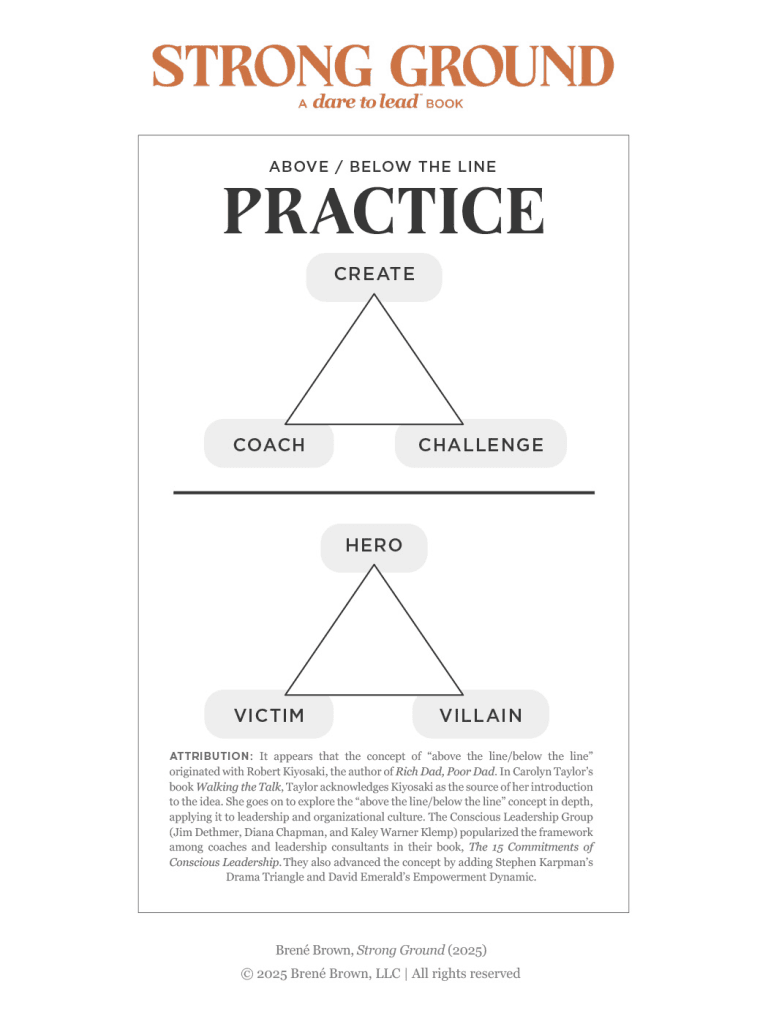
Practicing self-awareness in this context helps us to understand what our current conditions are to be curious.
This is why I’ve ordered this series the way I have. Connection, resilience, curiosity. Not because it is a linear process, but more that they are considerations to grow and expand from solid ground.
Because when the nervous system is chronically dysregulated, when we are running on borrowed energy, when we are disconnected from ourselves – we can be too busy surviving to wonder.
But when we are rooted – connected, steady, resilient – we can be more open to possibility and learning. As Grace Lordan, Associate Professor at LSE, notes: we consistently underestimate our ability to bounce back – and that underestimation is one of the greatest barriers to curiosity and growth.
Curiosity is a mindset. And it becomes more available when we create the conditions for it.
The permission to not know
One of the shifts that curiosity requires is the willingness to begin without knowing where something leads.
To pick up the pen without deciding what to draw. To ask the question without knowing the answer. To follow the thread – messy, imperfect, trusting the process rather than clinging to the outcome.
This is what creativity actually looks like before the world teaches us to be self-conscious about it. Not polished. Not purposeful. Just open.
And when we allow that – when we give ourselves genuine permission to explore without agenda, the grip of control loosens and we begin to feel more confident in exploration mode. The confidence of simply being willing to find out.
This is curiosity transforming fear into possibility.
The tapestry
There isn’t a blueprint for curiosity. There are threads.
And if we follow that thread, we begin to notice that the threads are connecting. The things explored out of genuine interest, the unexpected directions, the questions that led somewhere we didn’t expect – all of it weaving together into something that feels coherently, authentically, deeply ours.
A life built not by design, but by following what makes us feel alive.
This, I believe, is what Mary Oliver’s question is really asking. Not what you plan. Not what makes sense. But what makes you feel most fully yourself – and whether you’re willing to follow that, wherever it leads.
Next week — we close the series with our fourth superpower. Owning Our Authenticity. The courage to be exactly who you are.
A practice for this week
Find five minutes away from a screen and a task list.
Pick up a pen. Open a notebook. Without deciding what you’ll write or draw – just start. A word. A shape. A question. Anything that comes up. See where it takes you.
What does Mary Oliver’s question stir in you?
A note on the series
These four superpowers – Connection, Resilience, Curiosity and Owning Our Authenticity – are an invitation to get curious about what your own might be. Because the ones that matter most will be uniquely, irreplaceably yours.